Why do I have persistent Ice dams? Why does my roof look older than it should? Why is there mold in my attic? Why does the inside of my attic have frost in the winter? WHY DOES MY ROOFER KEEP TALKING ABOUT VENTILATION?
Hopefully this article can start answering these questions. Proper ventilation in your attic is crucial to your roof, your attic, and your living space. Let’s dive into what I am talking about, but I’ll start by saying, ventilation is a large topic with a lot of aspects to discuss, I expect I’ll be writing a lot more articles on this topic, so this one will go over just the basics.
A little bit of history to open the topic. I live in the Northeast of the United States. So many of the homes built here are old. Like, really old in some cases. These homes were built before things like ventilation and insulation were understood, and the technology was inadequate. Not only that, but homes are increasingly becoming air tight as we continue to emphasize a more energy efficient building code. The result is that homes do not vent naturally anymore, leaving deliberate ventilation solutions increasingly important.
As our understanding has grown, and our homes have become more efficient, attic ventilation science has become increasingly necessary and increasingly prescriptive. The international building code now has specifications for ventilation, which we will save for another article.
Side note: If your home was built in the last thirty years, you probably have good ventilation, but, I have seen homes built in 2010’s that lack proper airflow…so don’t take it for granted!
Ok, seriously though, why do I need ventilation?
I’m so glad you asked me. Your attic space is subject to elevated levels of warming all year around. The sun is the biggest factor affecting the temperature of the attic. All day long, the roof absorbs heat. Yeah, so what? Well, in Summer, that means that while your shingles are being cooked from the outside from the sun, they are also being cooked on the inside from the attic. They’re like a
pizza in an oven. Heating the shingles from both sides can do many things. You may notice blistering of the shingles, like the cheese of a pizza that's still in the oven. The super-heated shingles will become soft and malleable, causing them to start to melt away from the nails holding them in. It’s not just the shingles that are affected, the glues in the plywood roof deck start to “delaminate” a.k.a pull apart. From the outside this might look like a strange dip or hump in the roof. The plywood can also warp and deform, causing a similar issue. It’s not just the heat, but the constant fluctuations between hot days and cool nights. This causes frequent and unyielding expansion and contraction of the shingles, causing further breakdown of the materials.
In Winter, moisture in your attic that floats around the warm air during the day will condense in the overnight cold, forming a white frost on the underside of the deck and forming icicles on the roof nails. That moisture buildup can also lead to organic growth like mold spores. The constant moisture residing on the deck will slowly breakdown the integrity of the deck itself, compounding the issues with warping and delamination.
Long story short, the shingles, the deck and the roof system will not last as long without proper ventilation. In fact, all shingle manufacturers require proper ventilation to get the full warranty. (as a side note, if a roofer is discussing a manufacturer's warranty with you, but does not mention ventilation, this should raise a red flag! You may not be getting a voided warranty on day ONE!). In addition to the shortened life span of your roof, you’re also looking at a heat and moisture trap. I also mentioned Ice dams above. If you found this article in the winter of 2026…yeah, I feel ya. It was bad this year. If you’ve done a little homework, you probably know by now that warm air in your attic will melt the snow on your roof, causing it drip down to the bottom. Since warm air rises, the lower part of your roof is likely still cold, so the water freezes there. Once an ice dam starts to form, it will trap even more water dripping down and grow rapidly in size. We all know from grade school that water expands when it freezes, so that ice is going start working it’s way into any opening it can find, even uphill! It will pull apart shingles, get under flashing, siding, fascia, soffits, you name it, ice can get there. Once it’s in, you won’t know it until the next warm or sunny day when it thaws and starts dripping in your house. Through a light fixture, down the walls, cracks in the ceiling, chimneys…anywhere. How does ventilation help with this? It’s simple, keep the attic as cool as possible. Don’t let the snow melt. The best roofs in the winter will have an even, deep layer of snow long after the others in the neighborhood. (small caveat to that statement, some south-facing facets can still melt on a good
roof, but hopefully will not freeze at the bottom since the melting is coming uniformly from the sun and not from the upper parts of the attic).
What does good ventilation look like?
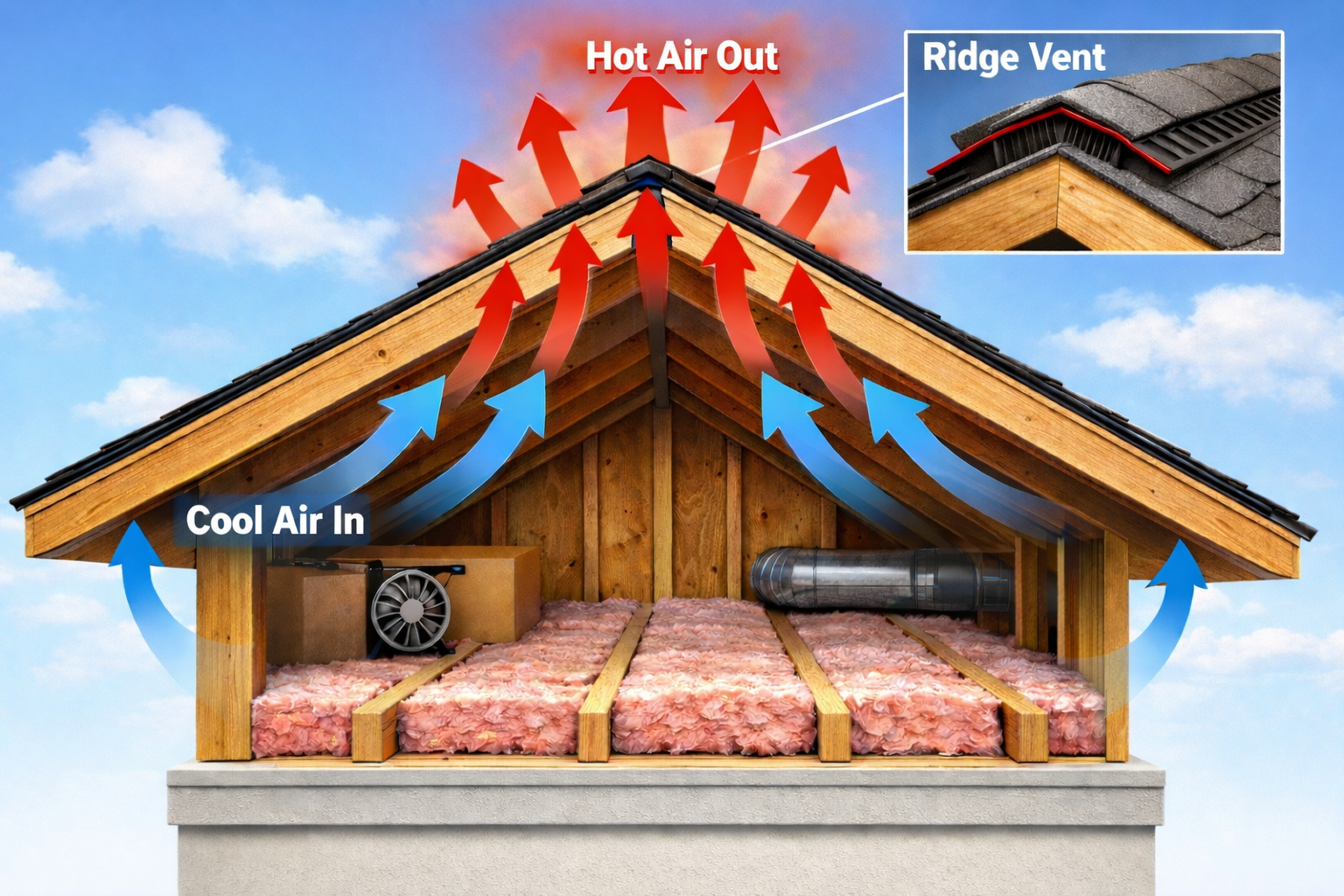
Good ventilation has intake and exhaust. The best ventilation will have the intake air coming in from the lowest part of the roof and exhausting from the highest point. The top and bottom should be balanced, in other words, equal amounts of intake and exhaust. Ideally, ventilation should be continuous and passive. What I mean by continuous is a long uniform intake along the bottom and the same on top, like a ridge vent. A non-continuous ventilation solution would be circle or square vents on the underside of an overhang and “box” or “mushroom” shaped vents along the top.
Although powered fans are great for moving large volumes of air through the attic, the introduce mechanical parts that are subject to wear. Passive is best; think of it as a set- it-and-forget-it solution. We could talk about the various ventilation types in depth, but I will save that for another article. Some home styles will find it challenging to have an adequate ridge line for a ridge-style vent. Others may struggle to get enough intakes. I’ll cover all that at another point.
As a final thought, many people have experienced noticeable improvements to the comfort of their homes, especially on upper floors after attic ventilation is installed. Think about it, if the attic is over 100 degrees in the summer, even the best insulation has a tough battle to keep the top floor at a comfortable temperature. If you have an HVAC system, it will be working overtime to keep that floor cool.
On top of all the benefits mentioned above, consider the additional savings on your energy bill if we can keep that attic cool and dry. Look out for more articles on ventilation in the future. I’ll dive into specific house designs that are challenging, different types of ventilation options, and much more.
Have questions?
Contact us today.